


Third Suzhou Forum on Humanistic Economics Held, Indicator System for China's Urban Humanities and Economic Development Released
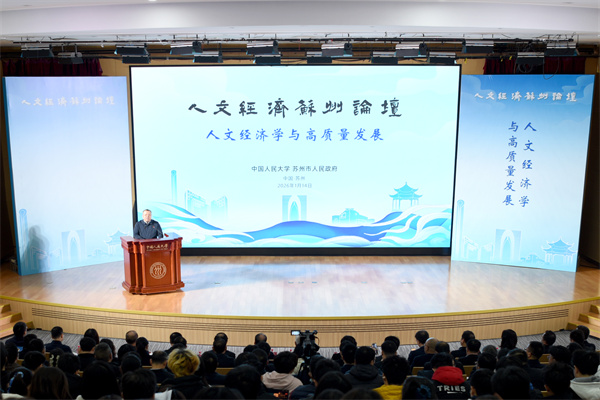
The Third Suzhou Forum on Humanistic Economics was convened on January 14 atSuzhouCampus of Renmin University of China. Focusing on the theme "Humanistic Economics and High-Quality Development," the forum was jointly organized by Renmin University of China and the Suzhou Municipal People's Government.
Attendees included officials from the Theoretical Bureau of the Publicity Department of the CPCCentral Committee; Wang Chengbin, Secretary of the Party Leadership Group and Vice Chairman of the Jiangsu Provincial Federation of Social Sciences; Liu Xizhong, Member of the Party Leadership Group and Vice Chairman of the Jiangsu Provincial Federation of Social Sciences; Jin Jie, Member of the Standing Committee of the Suzhou Municipal Party Committee and Head of the Publicity Department; and Wang Xiaohu, Member of the Standing Committee of the Party Committee and Vice President of Renmin University of China. The event brought together over 300 representatives from universities, government departments, and think tanks across the country.
In his address, Wang Xiaohu stated that Renmin University of China will continue to play a leading role in research, further the practice of humanistic economics in Suzhou, and focus on theoretical interpretation, experience summarization, and mutual learning among civilizations to contribute to Chinese modernization. Jin Jie emphasized that Suzhou is transforming its unique humanistic advantages into drivers for high-quality development, forming a closed loop of practice, research, promotion, and application. She expressed hope that the forum would pool wisdom to explore a path of symbiotic development between culture and the economy, offering more Suzhou experience. Wang Chengbin highlighted that the dynamic interaction between culture and the economy is becoming a significant engine for Chinese modernization.He expressed hope for deepening university-local collaboration to jointly paint a new picture of symbiotic coexistence and mutual prosperity between humanities and economics..
The forum invited experts including Jiang Xiaojuan, Hong Yinxing, Wang Xuedi, Sun Xing, and Gao Debu to deliver keynote speeches.They exploredtopics from digital governance and the connotations of humanistic economics to traditional culture and the economy, industrial aesthetics, and theoretical system construction.
Song Lu, Executive Dean of School of Smart Governance at Renmin University of China, released Research Report on China's Urban Humanities Economy Development Indicator System. This report established a “tripartite six-directional” evaluation framework and conducted comparative analyses using Suzhou and Hangzhou as case studies.
During the forum, Liu Xizhong, Shen Dan(Deputy Secretary-General of the Suzhou Municipal Government), and Zhang Xiaobo (Party Secretary ofSuzhou Campus of Renmin University of China), jointly inaugurated the Suzhou Key Laboratory for Big Data and Humanistic Economic Studies.Concurrently, the “Alliance for Building an Independent Knowledge System in Chinese Humanities Economics,” initiated by Renmin University of China and co-founded by multiple universities, was formally established. Jin Jie and Wang Xiaohu jointly launched the “Suzhou Visiting Scholar Program” for doctoral students nationwide.
Using Suzhou's practice as a sample, this forum advanced theoretical construction and empirical research in humanistic economics, aiming to deepen the mutual empowerment of humanities and economics and serve the broader national development agenda.,